

Autism Assessment for Children & Adults
Lycali provides comprehensive, neuroaffirming autism assessments for children and adults. Our assessments are designed to help you understand strengths, differences, support needs and whether diagnostic criteria for autism are met.
We use structured clinical assessment, developmental history, observation and information from relevant settings to build a full picture of how autism may present across everyday life.
Is an Autism Assessment Right for Me or My Child?
Autism can affect communication, social interaction, sensory processing, routines, flexibility, relationships and day-to-day functioning. It can present differently in children, adults, girls, women, boys and men, and many people learn to mask or camouflage their differences.
Children
May show differences in play, social interaction, communication, routines, sensory responses, transitions, friendships or emotional regulation.
Adults
May experience social exhaustion, masking, sensory overwhelm, relationship difficulties, anxiety, burnout or lifelong feelings of being different.
Not Sure?
Our free screening questionnaires can help you consider whether a full assessment may be beneficial.
Free Autism Screening Questionnaires
Screening questionnaires are not diagnostic, but they can help identify whether further assessment may be worth considering.
Child Autism Screening
For parents and carers considering whether a child may benefit from further assessment.
Start ScreeningAdolescent Autism Screening
For older children and teenagers where social, sensory or communication differences may be emerging.
Start ScreeningAdult Autism Screening
For adults exploring whether lifelong experiences may be consistent with autism.
Start ScreeningWhat We Explore
Social Communication
Conversation, understanding social cues, friendships, interaction style, non-verbal communication and social confidence.
Routines & Flexibility
Need for predictability, transitions, changes in plans, repetitive behaviours, intense interests and coping with uncertainty.
Sensory Differences
Responses to noise, light, textures, smells, movement, touch, busy environments and sensory overwhelm.
Masking & Burnout
How individuals may hide differences, copy social behaviour, appear to cope outwardly, or become exhausted after social demands.
Relationships
Friendships, family relationships, work or school interactions, misunderstandings, conflict and support needs.
Functional Impact
How differences affect education, work, daily life, emotional wellbeing, independence and access to support.
Autism Assessment Options
Child Autism Assessment
- Pre-assessment questionnaires
- Developmental history interview
- ADOS-2 clinical observation
- School information or observation where required
- Feedback meeting
- Comprehensive report and recommendations
Adult Autism Assessment
- Pre-assessment questionnaires
- Developmental history and informant information where available
- ADOS-2 clinical observation
- Feedback meeting
- Comprehensive report and recommendations
Combined Autism & ADHD
- Child Autism & ADHD Assessment: £2600
- Adult Autism & ADHD Assessment: £2250
- Suitable where autism and ADHD traits are both present
- Integrated report and recommendations
What Happens During the Assessment?
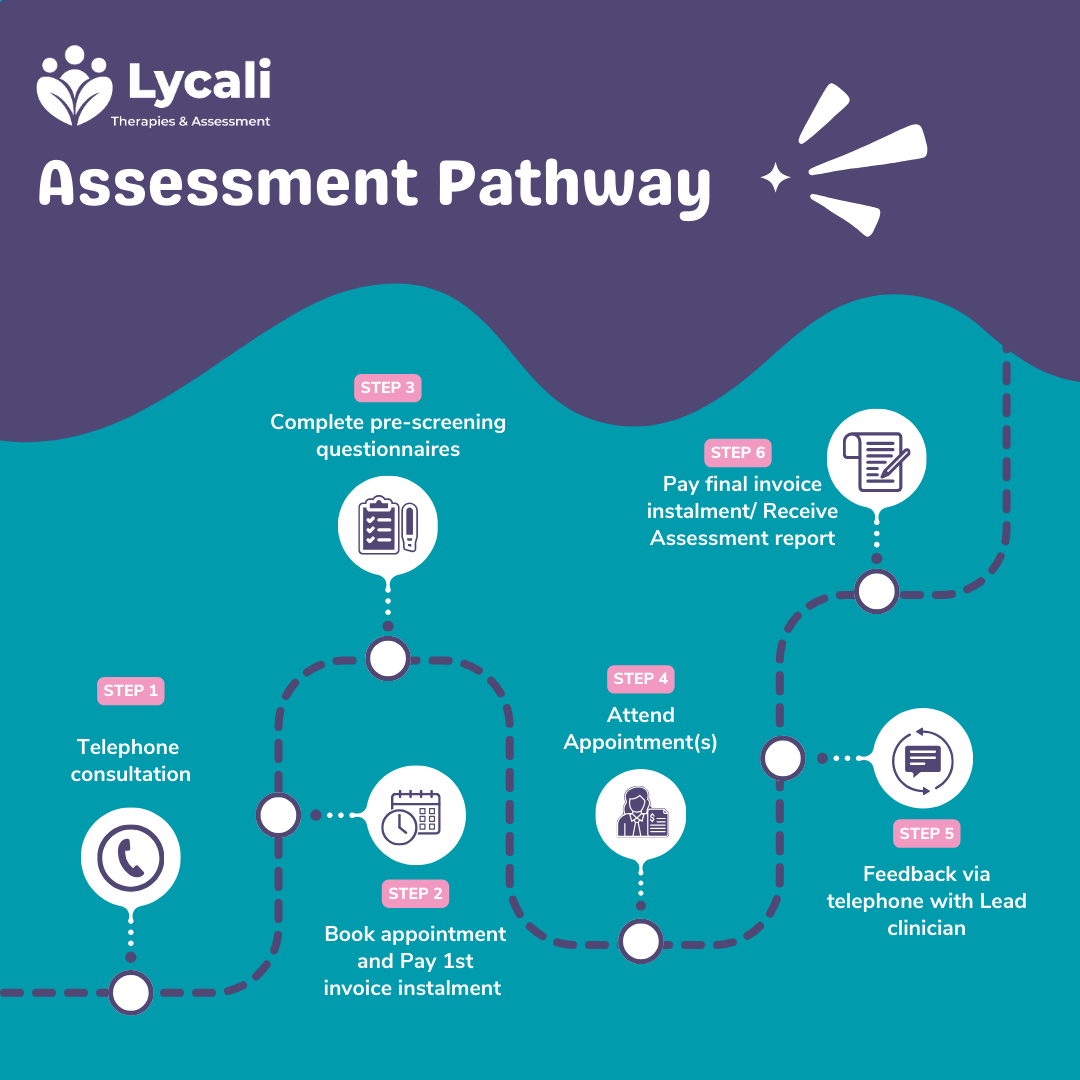
Our team reviews your enquiry and guides you to the most appropriate pathway.
You will complete forms about developmental history, current presentation and daily functioning. For children, educational setting information may also be requested.
A detailed developmental interview, such as the ADI-R or equivalent, explores early development, communication, play, social interaction, sensory experiences and behaviour over time.
The ADOS-2 is used to explore current social communication, interaction, flexibility, interests and behaviour in a structured but supportive way.
Clinicians review the evidence, provide feedback, explain whether diagnostic criteria are met and produce a comprehensive report with recommendations.
Who Attends?
Child Assessment
A parent or primary caregiver usually attends the developmental interview. The child attends the ADOS-2 appointment. A parent may remain present if clinically appropriate.
Adult Assessment
The adult attends the clinical assessment. Where possible, someone who knew them in childhood may provide developmental history, but we can still discuss options if this is not available.
School or Setting Input
For children and young people, we may request information from school, nursery, college or another educational setting to understand presentation across environments.
Autism Assessment FAQs
We know that families and adults often have questions about who can have an autism assessment, what information is needed and what happens during the process. You can find answers to some of the most common questions below.
What age can a child have an autism assessment with Lycali?
Lycali provides autism assessments for children and young people where there are concerns about social communication, interaction, sensory processing, routines, flexibility, play, relationships or other developmental differences.
The most appropriate pathway will depend on the child's age, developmental profile, communication needs and the information already available. If you are unsure whether your child is ready for an assessment, please contact us and we can help guide you.
Can adults have an autism assessment even if they were never identified in childhood?
Yes. Many autistic adults are not identified during childhood.
Some people develop strategies for managing or masking social, communication or sensory differences, while others may only begin to recognise an autistic profile after learning more about autism, experiencing burnout, or following the diagnosis of a child or family member.
What assessment tools does Lycali use for autism?
Autism assessment considers information from several different sources rather than relying on one test or questionnaire.
Depending on age and individual circumstances, the assessment may include:
- ADOS-2 structured clinical observation
- ADI-R or another detailed developmental-history interview
- Pre-assessment questionnaires
- Developmental history
- Parent or caregiver information
- School, nursery, college or educational-setting information where appropriate
- Informant information for adults where available
- Clinical interview and observation
- Information about sensory processing, relationships, routines, flexibility and everyday functioning
- Multidisciplinary clinical review
The exact assessment pathway is tailored to the person being assessed.
What is the ADOS-2?
The Autism Diagnostic Observation Schedule – Second Edition (ADOS-2) is a structured clinical assessment used to explore social communication, interaction, flexibility, interests and behaviour.
The activities and conversation used during the appointment vary depending on the person's age, communication style and developmental level.
The ADOS-2 forms one part of the wider autism assessment and is not used by itself to determine whether someone is autistic.
What is the ADI-R?
The Autism Diagnostic Interview – Revised (ADI-R) is a detailed developmental interview usually completed with a parent, caregiver or someone who knows the person's developmental history well.
It explores areas such as early development, communication, social interaction, play, interests, routines and behaviour over time.
Where the ADI-R is not the most appropriate tool, another comprehensive developmental-history approach may be used.
Does having an ADOS-2 mean I or my child will receive an autism diagnosis?
No. The ADOS-2 is an important source of clinical information, but autism is not diagnosed from the ADOS-2 alone.
The clinicians consider the full assessment evidence, including developmental history, current presentation, functional impact, information from other settings and whether another explanation may better account for the person's experiences.
Does my child need to have delayed speech to be autistic?
No. Autistic children can have a wide range of speech, language and communication profiles.
Some children have delayed speech or language development, while others develop spoken language within expected timescales but experience differences with conversation, social communication, understanding implied meaning, relationships, sensory processing or flexibility.
Can someone be autistic and make eye contact?
Yes. Eye contact alone does not determine whether someone is autistic.
Some autistic people make frequent eye contact, some make limited eye contact and others may consciously use eye contact because they have learned that it is socially expected.
Assessment considers the wider pattern of communication, interaction, sensory and developmental differences rather than individual behaviours in isolation.
Can autism look different in girls and women?
Yes. Autism can present differently across individuals, and some girls and women may mask or camouflage their differences.
This can include copying social behaviour, rehearsing conversations, appearing socially confident while experiencing significant internal effort, developing intense but socially typical interests, or becoming exhausted after social interaction.
What is masking?
Masking or camouflaging describes the strategies some autistic people use to hide, minimise or compensate for autistic differences in order to fit into social expectations.
This may involve copying other people's behaviour, scripting conversations, forcing eye contact, suppressing movements or sensory responses, or carefully monitoring how they appear to others.
Masking can make autism less obvious to other people and may contribute to exhaustion, anxiety or burnout.
What if my child behaves differently at school and at home?
This is common and does not automatically rule autism in or out.
A child may cope differently depending on structure, sensory demands, relationships, predictability and how much effort they are using to manage or mask their differences.
The clinician considers information from different environments and explores why presentation may vary.
Does the school need to agree that my child is autistic?
No. Schools do not diagnose autism and the assessment outcome is not determined by whether an individual teacher believes that a child is autistic.
However, information from school or another educational setting can be helpful because it provides additional information about communication, relationships, sensory needs, flexibility and functioning in another environment.
What if my child is doing well academically?
Academic achievement does not rule out autism.
Some autistic children and young people achieve highly academically while experiencing significant difficulties with sensory processing, friendships, transitions, uncertainty, emotional regulation, social exhaustion or managing the demands of the school day.
Can someone have both autism and ADHD?
Yes. Autism and ADHD can occur together.
Where both autism and ADHD appear relevant, Lycali can discuss whether a combined Autism & ADHD assessment may be the most appropriate pathway.
Can autism occur alongside dyslexia, dyspraxia or other learning differences?
Yes. Autistic people may also have ADHD, dyslexia, dyscalculia, developmental coordination differences, speech and language differences or other neurodevelopmental profiles.
The assessment aims to understand the whole person's profile and identify where further assessment or support may be helpful.
What if my child already has an ADHD diagnosis?
An existing ADHD diagnosis does not prevent someone from being assessed for autism.
The clinician will consider areas of overlap between ADHD and autism alongside evidence that may indicate a distinct autistic profile.
What if I do not have someone who can provide my childhood developmental history?
You can still contact Lycali about an adult autism assessment.
Developmental information is valuable, but we recognise that some adults do not have access to a parent, caregiver or other person who knew them in childhood.
Where this is the case, the clinician can discuss what other sources of developmental evidence may be available and whether the assessment can proceed appropriately.
Do I need old school reports?
No. Old school reports can sometimes provide useful supporting information, but they are not required in every case.
If you have historic reports, educational records or previous assessments, you are welcome to provide them as part of the assessment.
Can anxiety, trauma or mental health difficulties occur alongside autism?
Yes. Autistic people can also experience anxiety, depression, trauma-related difficulties and other mental health needs.
Part of a comprehensive assessment involves considering the person's wider emotional and developmental history and understanding whether different conditions may be occurring together.
What happens if the assessment does not result in an autism diagnosis?
The purpose of assessment is to develop a clearer understanding of the person's profile rather than simply to confirm a diagnosis.
If diagnostic criteria for autism are not met, the clinicians will explain the findings and, where possible, discuss other factors that may help make sense of the person's experiences and support needs.
Recommendations and possible next steps will be included where appropriate.
Will I receive a written report?
Yes. Following clinical review and feedback, Lycali provides a comprehensive report summarising the assessment evidence, outcome and personalised recommendations.
Recommendations may relate to education, workplace adjustments, communication, sensory needs, emotional wellbeing, daily functioning or further support.
What is a PDA profile?
PDA is commonly used to describe a profile where a person experiences a strong need for autonomy and significant distress or anxiety around everyday demands.
Lycali can consider and describe demand-avoidant characteristics within a comprehensive autism assessment where clinically relevant.
Is PDA a separate diagnosis?
PDA is not currently a separate standalone diagnosis within the main diagnostic classification systems used in UK clinical practice.
Where relevant, clinicians may describe the person's demand-avoidant presentation and include recommendations tailored to their individual needs.
What can a PDA profile look like?
It may include significant distress around demands, a strong need for autonomy, attempts to avoid or negotiate everyday expectations, rapid changes in emotional state, differences between settings and difficulty responding to traditional behaviour-based approaches.
Does recognising a demand-avoidant profile change support?
It can. Recommendations may place greater emphasis on collaboration, flexibility, predictability, trust, reducing unnecessary demands and supporting emotional regulation.
Can Lycali support me or my child after an autism diagnosis?
Yes. Lycali provides post-diagnostic support including psychoeducation, neurodivergent coaching, psychological therapies, speech and language therapy where appropriate, and practical support around sensory needs, communication, emotional regulation, confidence and everyday functioning.
After Diagnosis: Support That Makes Sense
A diagnosis is often only the beginning. Lycali offers post-diagnostic support to help individuals and families understand autism, build practical strategies, manage sensory and communication needs, support emotional wellbeing and navigate education or workplace adjustments.
Why Lycali?
Experienced Clinicians
Assessments are completed by qualified, registered professionals with specialist experience in neurodevelopmental assessment.
Gold-Standard Tools
We use structured clinical tools such as ADOS-2 and ADI-R alongside developmental, functional and contextual information.
Practical Reports
Reports are written to support understanding, education, healthcare, workplace adjustments and future planning.
Neuroaffirming Approach
We focus on strengths, differences, needs and support rather than deficit-only language.
Ready to Take the Next Step?
Complete a referral form and our team will help you understand the most appropriate autism assessment or support pathway.

-
The fees are an accurate guide, but can vary depending on the service required. Please contact us for an individualised quotation.
*When applicable, we can provide means-tested discounts. If you're experiencing financial difficulties, please inform us, and we'll assess whether we can assist in covering part of the service expenses.
-
We accept payments via BACS Transfer.
-
We accept credit and debit card payments via Stripe for your convenience.
Please note that card payments are subject to a 2.99% processing fee, which will be added to the invoice total to cover transaction costs.
All payments are processed securely through Stripe, a trusted global payment provider.
-
For assessment services, we offer the option to pay in two instalments. The total fee can be split into two payments of 50%:
50% is payable at the time of booking to secure your assessment appointment.
The remaining 50% is due upon completion of the assessment, prior to the release of the final report.
There is no additional fee if paying via BACS.
Please note that any applicable card or Buy Now, Pay Later processing fees will be added if these payment methods are used.
-
If your assessment or therapy expenses are set to be covered by your private medical insurance, kindly provide us with your insurer details for seamless payment coordination between you and your insurance provider. Our affiliation encompasses registration with Aviva, AXA, BUPA and Vitality Health, facilitating a streamlined process for your convenience.
-
We are pleased to offer flexible payment options to make accessing our services easier. Clients can choose to pay via Klarna or PayPal “Buy Now, Pay Later”, subject to approval by the payment provider.
Please note that payments made using Klarna or PayPal Pay Later will incur an additional 4.99% processing fee, which will be added to the invoice total to cover transaction costs.
Availability of these payment options is subject to eligibility and approval by Klarna or PayPal, and we are unable to influence or guarantee approval decisions.
Our Payment Options

Autism Indicators
-
Children
Reduced or inconsistent response to their name, voices or sounds
Limited eye contact or face-watching
Difficulty understanding facial expressions or emotions
May not engage in typical back-and-forth conversation
May prefer playing alone or engaging with others on their own terms
Difficulty understanding social rules in games or play
May struggle to make or maintain friendships
Adolescents & Adults
Difficulty interpreting social cues such as body language, tone of voice or subtle emotional signals
May find small talk or group conversations challenging
Difficulty understanding non-literal language such as sarcasm, humour or idioms
May feel unsure about appropriate topics or boundaries in conversation
Social interaction may feel exhausting or confusing
-
Children
Becoming very upset with unexpected changes
Difficulty transitioning between activities
Strong preference for predictable routines
Repetitive play or interest in specific activities
Adolescents & Adults
Strong need for structure and predictability
Distress when routines or plans change suddenly
Preference for clear expectations and rules
Intense focus on particular interests or topics
-
Many autistic people experience the world differently through their senses.
This may include:
Increased sensitivity to noise, lights, textures or smells
Becoming overwhelmed in busy or crowded environments
Seeking certain sensory experiences (movement, pressure, repetitive sounds)
-
Difficulty understanding the perspectives or feelings of others
Challenges navigating friendships or romantic relationships
May appear socially naïve or overly trusting
May struggle with group dynamics or workplace communication
-
Autism can present differently in girls and women and is sometimes less easily recognised.
Common indicators may include:
Strong effort to mask or camouflage difficulties
Appearing socially capable but feeling exhausted afterwards
Intense interests that may appear socially typical (e.g. animals, books, celebrities)
Greater awareness of social differences leading to anxiety or low self-confidence
Difficulties with friendships that may involve conflict, exclusion or feeling misunderstood
-
Some boys and men may show more visible behavioural traits, such as:
Clear repetitive behaviours or routines
Strong focus on specific interests (e.g. trains, gaming, systems)
Reduced awareness of social rules or boundaries
More obvious social communication differences from an early age
-
PDA is a profile within the autism spectrum characterised by a strong need to resist everyday demands and maintain a sense of control and autonomy. This is not about “refusal” or “behaviour”, but rather a nervous system response to perceived demands and loss of control.
What this can look like:
Avoidance of everyday demands (e.g. getting dressed, school tasks, routines)
Strong need for autonomy and control over situations
Using a range of strategies to avoid demands, including:
Distraction or changing the topic
Negotiation or bargaining
Making excuses or delaying
Withdrawal or shutdown
Appearing socially confident, but struggling with deeper social understanding
Intense emotional responses when feeling overwhelmed or pressured
High levels of anxiety, particularly when expectations are unclear or unpredictable
Mood can change quickly depending on perceived demands
Difficulty with traditional behaviour management approaches (e.g. rewards, consequences)
May respond better to flexible, collaborative and indirect approaches
Reviews
-
![Five teal-colored stars arranged in a horizontal line, each with five points.]()
"Lycali provided a thorough and compassionate autism assessment. Everything was explained clearly, and I finally feel understood. I wish I’d done this sooner."
-
![Five teal stars in a row.]()
"I’ve worked with other services before, but Lycali stands out for their professionalism and empathy. My therapist helped me navigate some really difficult times with sensitivity and skill."
-
![Five teal stars on a black background with a rating of five stars.]()
I just wanted to say thank you to Dr Isobel Robb and Stephanie for making the assessment comfortable for both me and my parents to conduct. It was very thorough and the outcome will definitely help me in my future. I'm really thankful for receiving the results so quickly
-
![Five blue stars in a horizontal row.]()
“Thank you so much for all your help, support and care. You have explained everything we needed and thank you for saying I can get in touch if we need any more help.”
-
![Five blue stars arranged in a horizontal row.]()
“You were very patient with our son and always gave us ideas so that we could support him between therapy sessions. Thank you so much!”
-
![Five blue stars aligned horizontally.]()
“After our daughter's Speech and language assessment, you offered great feedback and your report was very detailed. This was a huge help towards the EHCP process.”
-
![Five blue stars aligned horizontally.]()
"My daughter’s speech has improved so much in just a few months. Our speech therapist at Lycali was kind, engaging, and always kept us involved with providing follow up activities. I highly recommend them."
-
![Five blue stars aligned in a horizontal row.]()
“Heidi was very engaging and really listened to the needs of my son. She explained her methods and gave us tips to try at home. We are really pleased with the service.”
-
![]()
“The calls have helped me to find more space and given me a safe space to discuss and release emotions. Tim's nature and communication is comforting and supportive, he adds thoughts and questions which offer space to analyse and to help growth.”
-
![]()
"Heidi was very enthusiastic and knowledgeable. She gave our son room to explore and enjoyable targets".
-
![Five blue stars arranged in a horizontal row.]()
"Heidi was very patient with my child and has made him confident to use his voice"
-
![Five teal stars aligned horizontally with a black background.]()
"I can’t thank you enough for your help and support with my son. I will most certainly be coming back to your services again for an autism assessment".
-
![Five teal stars in a row on a transparent background]()
"The ADHD assessment process was seamless, evidence-based, and respectful. I felt listened to throughout, and the diagnosis has helped me finally understand myself."
-
![Five blue stars in a row on a black background.]()
Everything has been amazing so thanks to you, Isobel and Stephanie. You have made things really easy with clear and quick communication and they really created a safe environment instantly.
-
![]()
Thank you so much. It was a pleasure working with your staff. They were really kind and helpful and made the process easier for both me and Matilda.
-
![Five teal five-pointed stars arranged in a horizontal line.]()
"We had a brilliant experience with Lycali. The assessment process was clear, kind, and professional from start to finish. My son felt at ease, and we finally have a clear plan for supporting his needs."
-
![Five teal five-pointed stars aligned horizontally.]()
"I was nervous about starting therapy, but the team at Lycali made me feel heard and respected from day one. Their care was outstanding, and the progress I’ve made is life-changing."

Leave us a review on Google: Leave a review
Lycali offers a professional and friendly service where time and attention can be taken to ensure the service received is of the highest standard and there is minimal waiting time. Our specialist team will always take the time to provide expert advice so you are aware of all the pre-and post-diagnostic and therapy services available. Our clinics are suitable for children and adults, and based in Thanet and Surrounding areas. We provide online or in-person therapy sessions.
About Lycali



Because Every Individual Deserves to Be Understood